
Digging Smarter: How Proceq and CLIMBS Are Building Kentucky’s Paleoenvironmental Record
Dec 19, 2025
Building Kentucky’s paleoenvironmental record requires a lot of digging. Boreholes, trenches, and dirt under the nails. Researchers from CLIMBS Project 2, Paleo-perspectives, are studying sediment layers stacked by the hundreds to reveal how often Kentucky flooded and how long those floods lasted, to better anticipate future hazards. Simply put, digging isn’t going away anytime soon. But thanks to a new partnership, CLIMBS geologists can now dig smarter, not harder.
This November, CLIMBS entered a private–public partnership that can reshape how geology students and researchers build the record of Kentucky’s recent environmental history. Proceq is a global company behind advanced ground-penetrating radar systems and other non-destructive testing techniques. It has joined forces with the CLIMBS project, and it’s already transforming how Kentucky maps hazards, trains talent, and uncovers the stories written beneath our feet.
At the center of this collaboration is Patrick Baldwin, a University of Kentucky Earth & Environmental Sciences alumnus whose career path from academia to industry now brings ground-penetrating radar (GPR) back to his alma-mater. Baldwin is a now Senior Field Application Engineer with Proceq. “This [partnership] is a great win for [Proceq] Screening Eagle, [the Kentucky Geological Survey] KGS and the CLIMBS project,” Baldwin said. “For the students coming through the universities, hopefully when they enter the workforce, they will have some knowledge about ground-penetrating radar.”
Baldwin’s connection to the partnership is as personal as it is professional. After graduating from UK in 2016 and working in an industrial position that immediately put GPR in his hands, he learned the value of exposing students to modern geophysical tools early in their training. That vision now helps drive his involvement with CLIMBS.
“I’m honored to come back and work with [KGS Director] Mike McGlue, KGS, and EES,” he said. “It’s exciting to come back and educate current students using this technology.”
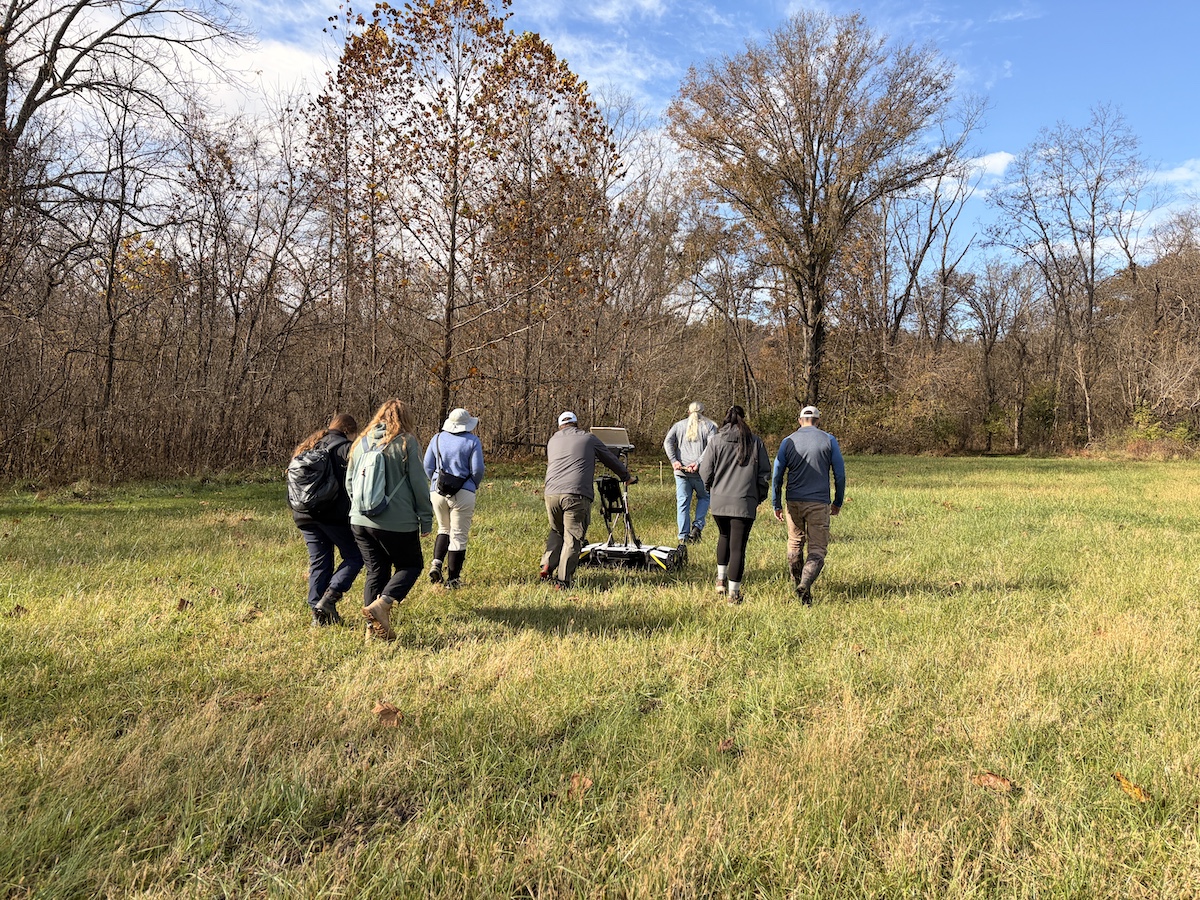
With Baldwin leading the way, Proceq committed its time, staff, and technology to support CLIMBS Project 2 in mid-November at Big Bone Lick State Historic Site, a hotbed of paleontological interest. For three days, CLIMBS researchers and students from KGS, the University of Kentucky, Morehead State University, Western Kentucky University, joined forces in an interdisciplinary effort that showcased the possibilities of the partnership.
The team used Proceq’s GS9000 and GS8000 GPR systems, KGS’s SuperSting electrical resistivity array, EES’s low-frequency Mala GPR unit, and shear wave geophones to collect complementary subsurface data, while CLIMBS researchers scouted nearby creek sites for future student-led work. The week wrapped up with a hands-on software training session led by Proceq’s Dean Goodman, giving students and researchers experience with the same advanced visualization and processing tools used in professional geophysical surveys. This advanced field training was an invaluable experience for many undergraduate students onsite.
“They showed us a really robust software that can really do a lot for EPSCoR Project 2,” said Hannah Sprinkle, a senior geology student at Morehead State University. “Seeing people from different geological backgrounds work together for one common goal—and involve us as undergraduates—is a really big deal.”
“For a small university like Morehead State, collaboration with Proceq and CLIMBS unlocks capabilities previously out of reach,” said Jen O’Keefe, Hannah’s mentor and professor at Morehead State. “Because of this partnership,” O’Keefe added, “we can give advanced opportunities to our students for experiential learning. We can—for the first time—train students on how to use ground-penetrating radar, which helps us determine where the best records are before we dig trenches or boreholes.”
Over the three-day period, the team used the GS9000 to map sediment layers, hoping to reveal details of the shallow stratigraphy, or the sequencing of rock layers, that represents recent environmental conditions in Boone County. The stratigraphy was challenging to image, in part because of a sprawling metropolis of gopher tunnels just beneath the surface. Real-time visualization and GNSS data helped the team spot voids that traditional methods would have missed. With some follow-up processing, the gopher tunnel discovery demonstrated the power of the technology to visualize shallow geological processes like bioturbation, or the disruption of sediments by burrowing animals.
“Sometimes you go out to the job site looking for something specific, and end up finding something totally unexpected,” Proceq gave in a statement.
The CLIMBS and Proceq partnership fosters collaboration on a scale that is rare in academic research. By enabling faster and more comprehensive subsurface mapping, providing access to professional-grade instruments and analytics, and creating direct training pathways that connect students to industry, this partnership is an excellent example of how public universities and private companies can work together to advance science and strength the workforce pipeline.
CLIMBS co-PI and co-lead of Project 2, Mike McGlue, stresses the importance of this partnership stating, “Training students and learning more about Kentucky’s recent history is at the core of the CLIMBS mission – both help the Commonwealth build resilience. I’m proud to be collaborating with Patrick and the Proceq team at a world class site right here in Boone County.”
Most importantly, this partnership will help train the next generation of Kentucky geoscientists to solve the problems of today and tomorrow.
And for Baldwin, that’s the heart of it.
“Hopefully when these students enter the workforce,” he said, “they’ll already know how to use this technology—and they’ll be ready to lead.”
See the full case study, plus other real archaeological case studies on our Tech Hub.