Advancing Cement and Supplementary Cementitious Materials (SCMs) Evaluation with ASTM C1952: A New Benchmark for Bulk Resistivity Testing Using the Proceq Resipod
Strength testing is no longer enough to characterize the next generation of low-carbon cement. Durability Engineers explore how bulk resistivity testing is revolutionizing Supplementary Concrete Materials (SCMs) evaluation, providing a more complete understanding of long-term durability and material performance.


Newsletter
Get the best NDT and InspectionTech content delivered straight to your inbox
Overview
Supplementary cementitious materials and emerging binder systems continue to be developed and implemented as the construction industry incorporates materials intended to lower the carbon footprint of concrete. Strength remains an essential parameter for evaluating these materials; however, strength alone does not characterize reactivity, pore structure development, or resistance to fluid ingress.
In June 2025, ASTM published ASTM C1952 – Standard Test Method for Determination of Bulk Resistivity Index of Mortar Cubes Using Bulk Electrical Resistivity Measurements.¹ The test method provides a standardized procedure to measure the bulk electrical resistivity of 2-inch (50 mm) mortar cubes conditioned in lime-saturated water and to calculate a Bulk Resistivity Index relative to a portland cement control. This approach enables an assessment of microstructural refinement using the same mortar cubes tested for Strength Activity Index (SAI).²
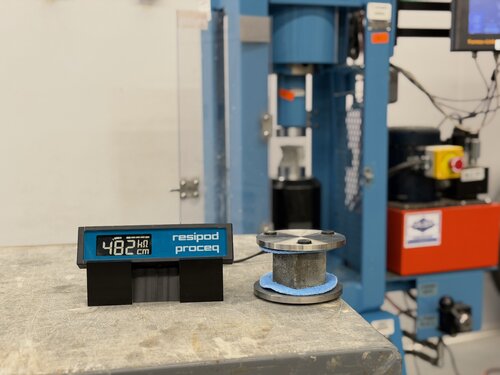
Durability Engineers (DE) has implemented ASTM C1952 in ongoing research programs focused on evaluating a range of supplementary cementitious materials. Bulk resistivity was measured using the Proceq Resipod prior to compressive strength testing, allowing a direct comparison between reactivity, strength development, and changes in pore structure.
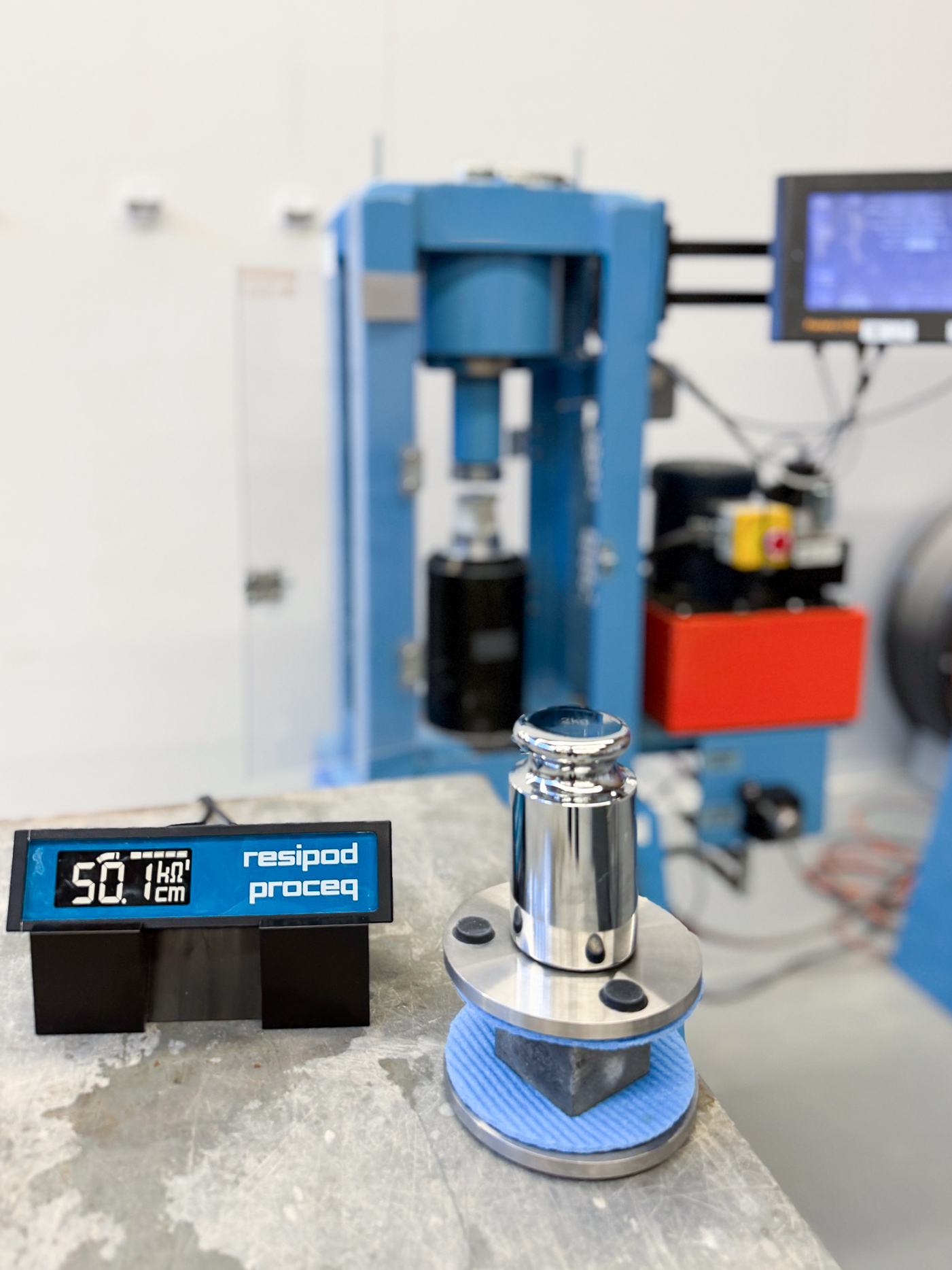
Laboratory setup of Proceq Resipod during bulk resistivity measurement of mortar cubes.
Background: Strength Testing Limitations and the Role of Bulk Resistivity
Traditional evaluation of supplementary cementitious materials relies on the Strength Activity Index (SAI) defined in ASTM C618³ and ASTM C989⁴. Although SAI provides a measure of relative strength, it does not quantify the material’s influence on pore volume, pore connectivity, or pore solution chemistry.
Research summarized in literature and technical papers notes that electrical resistivity correlates with resistance to the transport of ions and fluids in cementitious materials. ASTM C1952 standardizes the measurement of bulk resistivity on mortar cubes and defines the Bulk Resistivity Index (BRI) as the ratio of the resistivity of an SCM mortar to a control mixture. Studies referenced in Hooton (2025)⁵ and Obla (2024)⁶ demonstrate that reactive SCMs consistently yield higher BRI values than inert fillers, even when strength differences are modest.
Methodology: Integrating into SCM Evaluation
For DE’s research, mortar cubes were prepared using the mixture proportions and procedures defined in ASTM C109⁷ and ASTM C1952. SCMs were evaluated at standardized replacement levels (20 percent for SCMs). Each cube was conditioned in lime-saturated water, tested for bulk resistivity using the Proceq Resipod, and then immediately tested for compressive strength. The combined results provide a more complete understanding of material performance than strength alone.
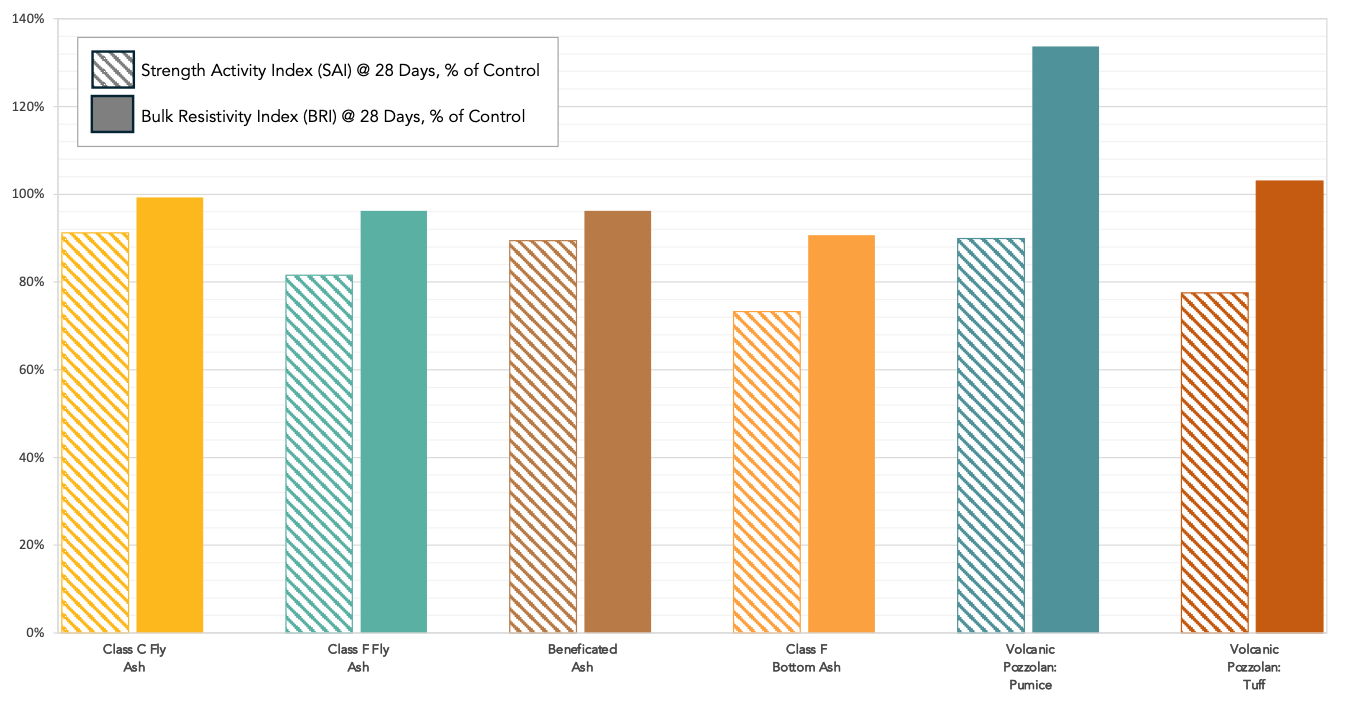
Laboratory correlation between Strength Activity Index (SAI) and Bulk Resistivity Index (BRI) for tested SCMs.
Advancing Materials Development and Durability Research
ASTM C1952 supports performance-based evaluation of SCMs by incorporating microstructural parameters into traditional screening workflows. DE has extended this approach to concrete specimens through complementary bulk (ASTM 1876) and surface resistivity measurements (AASHTO T358-15), all attainable with the Proceq Resipod system. The combined data illustrates how SCMs influence microstructure development and potential durability in service environments.
Bulk resistivity testing with devices such as the Proceq Resipod has demonstrated low variability, with coefficients of variation near 3 percent at both 7 and 28 days under standardized conditions (as reported in the precision section of C1952).
References
[1] ASTM International. ASTM C1952-25, Standard Test Method for Determination of Bulk Resistivity Index of Mortar Cubes Using Bulk Electrical Resistivity Measurements. West Conshohocken, PA, 2025.
[2] ASTM International. ASTM C311/C311M, Standard Test Methods for Sampling and Testing Fly Ash or Natural Pozzolans for Use in Portland-Cement Concrete. West Conshohocken, PA.
[3] ASTM International. ASTM C618, Standard Specification for Coal Fly Ash and Raw or Calcined Natural Pozzolan for Use in Concrete. West Conshohocken, PA.
[4] ASTM International. ASTM C989/C989M, Standard Specification for Slag Cement for Use in Concrete and Mortars. West Conshohocken, PA.
[5] Hooton, R.D. Use of a Bulk Resistivity Index to Evaluate the Permeability Performance of Blended Cements and Supplementary Cementitious Materials. Proceedings of the First McCarter International Symposium on Advances in Concrete Testing and Monitoring, Heriot-Watt University, Edinburgh, UK, 2025.
[6] Obla, K.H. A Limited Performance Evaluation of Natural Pozzolans Using the Bulk Resistivity Test. National Ready Mixed Concrete Association (NRMCA), Alexandria, VA, 2024.
[7] ASTM International. ASTM C109/C109M, Standard Test Method for Compressive Strength of Hydraulic Cement Mortars (Using 50-mm [2-in.] Cube Specimens). West Conshohocken, PA.