ASTM A1038-2026: Major Revisions to UCI Hardness Testing Verification
ASTM A1038-26 is officially published — and it changes how UCI instruments must be verified. See how the new revision introduces two significant changes that directly affect instrument qualification and field use.


Newsletter
Get the best NDT and InspectionTech content delivered straight to your inbox
New Changes in UCI Instrument Verification
ASTM A1038-26 is officially published — and it changes how UCI instruments must be verified. For anyone working with Ultrasonic Contact Impedance (UCI) hardness testing in safety-critical environments, this update is important.
The new revision introduces two significant changes that directly affect instrument qualification and field use.
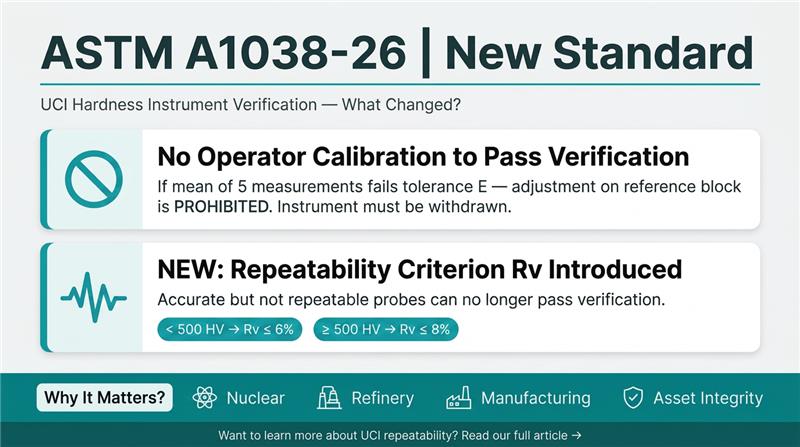
❌ Calibration can no longer be used to force a verification pass
Under the previous standard, operators could adjust a UCI instrument using a steel reference block after verification — even when the device was clearly underperforming. That practice is now explicitly prohibited.
If the mean of 5 measurements falls outside the permissible error tolerance E, the instrument fails verification. No operator-level adjustment is allowed to bring it back into compliance. A failing instrument must be withdrawn from service and sent to the manufacture or service center for professional assessment.
This change closes a long-standing loophole that allowed degraded or poorly maintained probes to remain in operation — often undetected.
✅ New mandatory criterion: Repeatability Rv
This is arguably the most impactful change in ASTM A1038-26. Previous versions of the standard only required the mean of at least 5 measurements to fall within tolerance. The spread of individual readings was not evaluated. A probe producing wildly inconsistent results could still "pass" — as long as the average looked acceptable.
The new standard closes this gap by introducing a mandatory repeatability criterion Rv, calculated as: Rv = ( (Xmax − Xmin) / Xref ) × 100 Maximum permissible repeatability limits are now defined:
📌 < 500 HV → Rv must not exceed 6%
📌 ≥ 500 HV → Rv must not exceed 8% Probes that produce inconsistent readings — even if their average appears within tolerance — will now be clearly identified and must be removed from service.
Why does this matter in practice?
UCI hardness testing is routinely used in environments where measurement integrity is non-negotiable:
- Nuclear power plants
- Oil refineries and petrochemical facilities
- Manufacturing process control
- Weld qualification
- In-service asset monitoring and structural integrity assessments
In these applications, measurements conducted with unreliable devices can lead to incorrect decisions — with consequences that go far beynd a failed audit.
The new ASTM A1038-26 requirements ensure that only instruments in genuine, verified working condition are used where it counts most. These changes reflect a clear direction: tighter controls, higher confidence, and better protection for both assets and people. The standard still demands calibration on reference test pieces from materials with different than standard Steel (E modlulus than 210 GPa +- 10 GPa).
Want to learn more about UCI repeatability and what Rv means for your verification workflow? Read our full article on what you should know about the accuracy and repeatability of portable hardness testing probes.