Beyond Manual Portable Hardness Testing: The Benefits of Motorized Probes
Discover how the new Equotip UCI motorized probes are enabling high-precision, onsite measurements of thin coatings and hardened surfaces by minimizing operator influence and stabilizing indentation depth.


Newsletter
Get the best NDT and InspectionTech content delivered straight to your inbox
Article Highlights
-
Bench-top hardness testers: Limited mobility, gravitational dependence, and time-consuming measurements
-
Portable UCI hardness testers: Overcome mobility and accessibility issues of stationary Vickers devices, allowing testing in all directions
-
Motorized UCI vs. manual UCI probes: Motorized probes reduce operator influence on the measurement and ensure higher measurement repeatability
-
Indentation depth considerations: Very low indentation depth requires careful surface preparation
-
Coating testing: Requires a minimum thickness of 10× the indentation depth per standards
Introduction
Bench-top Vickers hardness testers have long been the gold standard for precision hardness measurements, but they come with several practical challenges. These devices are large, stationary, and require a controlled environment, making them unsuitable for on-site applications. Since they rely on gravitational force, measurements are only performed from the top, limiting the flexibility of testing positions.
The measurement process itself is time-consuming, requiring sample preparation, indentation, and subsequent microscopic analysis. Every indentation must be optically evaluated, which introduces additional complexity and extends the time from measurement to result. Additionally, these devices struggle with accessibility, as larger or irregularly shaped components cannot always be placed inside the tester.
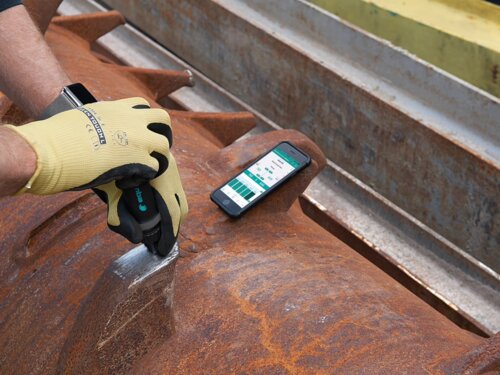
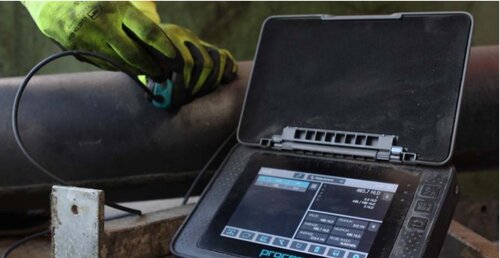
With these limitations, industries seeking mobility, faster measurements, and in-field testing capabilities turn to portable hardness testerssuch as UCI (Ultrasonic Contact Impedance) devices, which allow direct testing on-site and in any orientation.
Motorized Vs Manually Held UCI probes
The introduction of motorized UCI probes has brought a significant improvement in measurement accuracy and repeatability for test loads below 1kgf. Unlike manually operated probes, which require the user to apply force consistently, motorized probes automate force application, minimizing the user-induced variations. This is especially crucial in microhardness testing, where forces below 10N produce extremely shallow indentationsthat demand high measurement precision.
Another challenge with manually held probes is ensuring correct probe alignment. According to ASTM A1038, DIN 10159, and GB/T34205, the probe should not deviate more than ±5° from perpendicular to the test surface to maintain measurement accuracy. Achieving this level of precision manually can be difficult, especially when testing in awkward positions. A motorized probe ensures stable perpendicular positioning, significantly reducing operator influence and improving repeatability.
The importance of indentation depth cannot be overstated. With lower forces, the indentation is so small that detection is only possible under a microscope. This means high measurement resolution is critical, and any deviation in probe handling can drastically impact the results. Motorized probes combat this by standardizing indentation depth and force application, making them ideal for applications where precision and consistencyare paramount.
How deep does the indentation go?
Indentation depth is a key factor in hardness testing, influencing measurement accuracy and reliability. According to ASTM A1038, the depth of indentation is calculated using the formula:
h=0.062 (F/HV)0.5
where:
-
h = indentation depth (mm)
-
F = test force (N)
-
HV = material hardness (Vickers scale)
Shallow indentations present both advantages and challenges. While they allow for non-destructive testing and are beneficial for delicate surfaces, they also mean that high-resolution measurement equipment is necessary to ensure reliability. Additionally, a surface finish of Ra below 1.6 µm is recommended to avoid irregularities affecting the results. If the surface is too rough, the indentation may not be uniform, leading to inaccurate hardness values. The following map depicts the relationship between the test load, hardness and indentation depth. This is especially important for very hard surfaces, whereby the indentation depth can be as low as 3 µm. It is rare that operators can provide steady, vibration free operation without affecting the measurements with so low indentation.

Motorized probes especially suited for coating applications
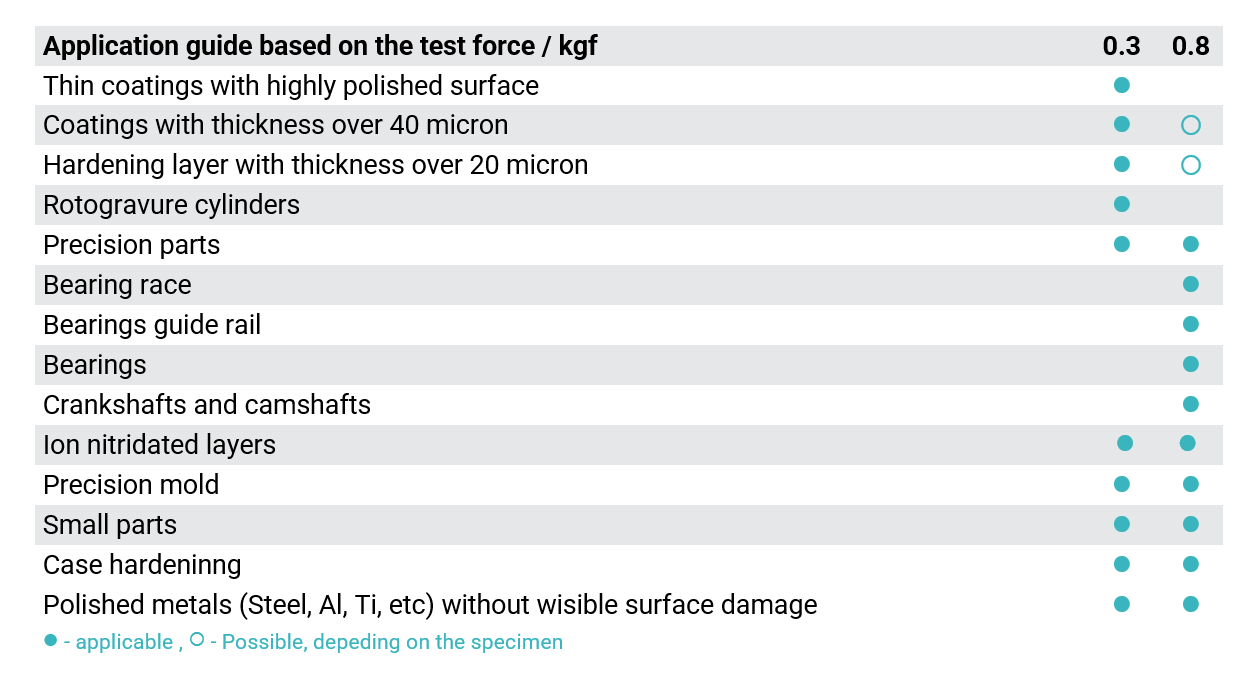
When testing coatings like chromium, nickel, and copper, as well as hardened surfaces from nitriding, carburizing, carbonitriding, and induction hardening, proper indentation depth control is crucial. The indentation depth must not exceed 10% of the coating thickness to ensure accurate measurement without substrate interference. Surface treatments result in thin, hardened layers that require precise testing methods like UCI to evaluate hardness effectively without excessive material damage.
Another critical factor in UCI hardness testing is material-specific calibration. The UCI method is typically calibrated for materials with a Young’s modulus of 210 GPa (common for steels). However, materials such as copper (110 GPa) or chromium (279 GPa) exhibit different elastic properties, affecting measurement accuracy. To obtain reliable hardness values, UCI testers must be calibrated against reference samples of the same material type, ensuring results accurately reflect material properties.
Motorized UCI probes are particularly well-suited for coating and surface treatment applications, as they provide precise and repeatable measurements at low indentation depths, ensuring compliance with industry standards. Their ability to deliver ultra-fast assessments makes them an essential tool for quality assurance and process control across various industrial applications. This ensures that coatings and hardened layers meet strict durability and performance standards while maintaining surface integrity. Moreover, precise and constant force application enables a post-hoc check of the indentation under the microscope and cross-check the measurements with the bench-top devices.
|
Comparison: UCI vs. bench-Top Hardness Testers |
|||
|---|---|---|---|
| Best for | Lab testing | On-site testing | Precision on-site testing |
| Feature | Bench-Top (Vickers) | Portable UCI (Manual) | Portable UCI (Motorized) |
| Measurement time | Long (optical analysis) | Short | Short |
| Mobility | Stationary | Portable | Portable |
| Operator influence | None (fixed setup) | Medium-high | Low with magnetic foot |
Conclusion
For industries requiring mobility, speed, and flexibility, portable UCI testers offer a compelling alternative to bench-top Vickers testers. While bench-top devices deliver high-precision hardness values, they are stationary, time-consuming, and limited in testing orientation.
UCI testers, on the other hand, enable on-site hardness testing in any direction, significantly reducing the time from test to result. Within the UCI category, motorized probes stand out, particularly in low-force applications where indentation depth is minimal, and measurement accuracy is critical. By ensuring consistent force application and reducing operator influence, motorized probes provide a reliable and precise hardness testing solution, especially for coatings and microhardness applications.
Ultimately, choosing the right hardness testing method depends on application requirements, testing location, and desired accuracy levels. Understanding the advantages and limitations of each method allows industries to optimize their testing processes and achieve reliable, repeatable, and accurate hardness measurementsin a variety of conditions.
References
Metallische Werkstoffe – Härteprüfung nach dem UCI-Verfahren – Teil 2: Prüfung und Kalibrierung der Härteprüfgeräte, DIN 50159-2:2015-01, 2015
Standard Test Method for Portable Hardness Testing by the Ultrasonic Contact Impedance Method, ASTM A1038-19, 2019
Metallic materials – Hardness testing – Ultrasonic contact impedance method, GB/T 34205-2017, 2017
Portable Hardness Testing. Theory practice, Applications, guidelines. Burnat, D., Raj, L., Frank, S., Ott, T. Schwerzenbach, Screening Eagle Technologies AG, 2022.
Metallic materials — Vickers hardness test —Part 2: Verification and calibration of testing machines. ISO 6507-2:2018