Subsurface Power Conduit Detection: GS9000 Dynamic Stacking in Action
Accidentally striking underground power lines can be catastrophic for urban construction. Read how the Proceq GS9000 uses real-time dynamic stacking to pierce through complex underground noise, boosting effective detection depth and keeping excavation projects safe.


Newsletter
Get the best NDT and InspectionTech content delivered straight to your inbox
How Dynamic Stacking Redefines Subsurface Power Conduit Detection
In the construction of urban roads and the operation and maintenance of power facilities, the accurate positioning of underground power conduit is the key link to ensure construction safety and avoid powerline damage. Traditional ground-penetrating radar is susceptible to interference in a complex electromagnetic environment, with deep signal blur and large imaging noise, which is difficult to meet the needs of high-precision detection of a power conduit.
Relying on its dynamic stacking technology, the Proceq GS9000 multichannel GPR has significantly improved the clarity, depth and reliability of underground detection through the upgrade of signal processing capacity, and has been applied in the emergency investigation project of power conduits.
Technical principle
GPR depth penetration is affected by random background noise from external sources such as broadcast transmitters, cellular networks, and other electromagnetic interference. As the GPR signal attenuates with depth, target reflections become harder to detect and may become “hidden” within the noise level.
Random background noise can be reduced by collecting multiple A-scans (traces) at the same location and averaging them, a process known as stacking. Stacking lowers the noise floor, revealing deeper target reflections and improving overall data quality.
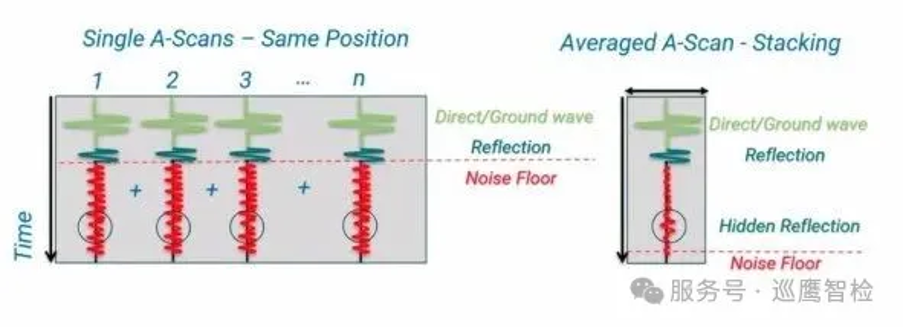
Stacking is a well-established technique in GPR technology and has been used for many years. However, its effectiveness is constrained by the system’s ability to acquire repeated traces at the same location and therefore strongly depends on acquisition speed.
Usually, a fixed number of stacks is set before data collection, which is not optimal, particularly for variable speeds. If too few stacks are selected, depth penetration may be limited. If too many stacks are selected, maximum scanning speed must be decreased. This requires users to determine a compromise between scanning efficiency and data quality.
Even though our MCGPR systems use state-of-the-art technology and offer very high acquisition speeds, this requirement increases proportionally with the number of channels and bandwidth, making optimal stacking challenging.
Dynamic Stacking Mode with GS9000 (and GM8000) automatically combines multiple consecutive radar traces in real time to improve SNR (signal-to-noise ratio). By lowering the effective noise floor, it enables clearer imaging and detection of deeper subsurface features. Dynamic stacking ensures collecting the maximum number of stacks adapted to the scanning speed.
Comparison between standard mode and dynamic stacking mode
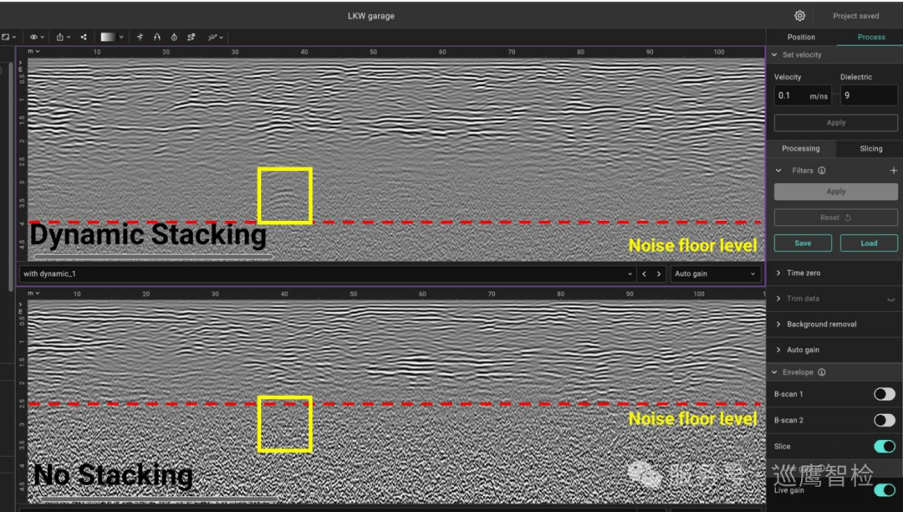
After enabling dynamic stacking, powerline signals can be clearly identified at a depth of 3 meters; when not enabled, a large amount of noise appears at a depth of 2.5 meters, and signals below 2.5 meters are completely covered by noise. The actual effective detection depth has been increased from 2.5 meters to 3 meters.
Application case - Background
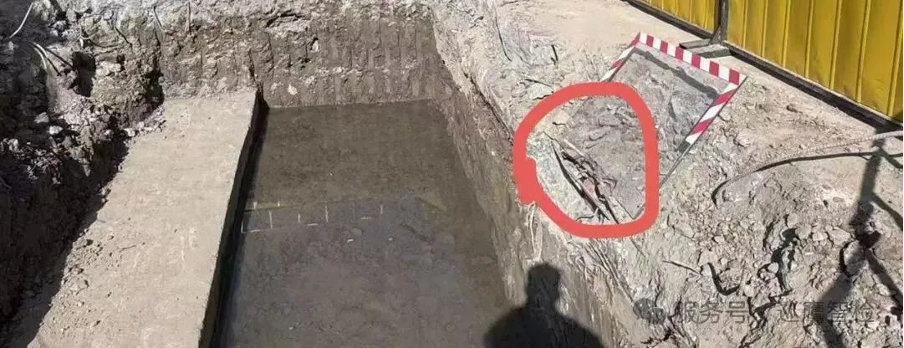
During the construction and excavation of a road, the underground power conduit was accidentally broken, which seriously affected the construction safety and power supply. In order to quickly locate the position, burial depth and direction of the remaining conduit and avoid secondary damage, it is necessary to complete the following tasks by non-destructive detection:
- Accurately identify the plane position and buried depth of the underground conduits.
- Clearly distinguish power conduit signals and exclude underground structures and electromagnetic interference.
- Provide reliable data to support subsequent construction and line repair.
Solution
After going to the scene, the engineer first adopted the standard scanning mode of GS8000 for detection. However, due to the interference of complex underground structures and surrounding high-frequency electromagnetic waves, the detection effect was not good.
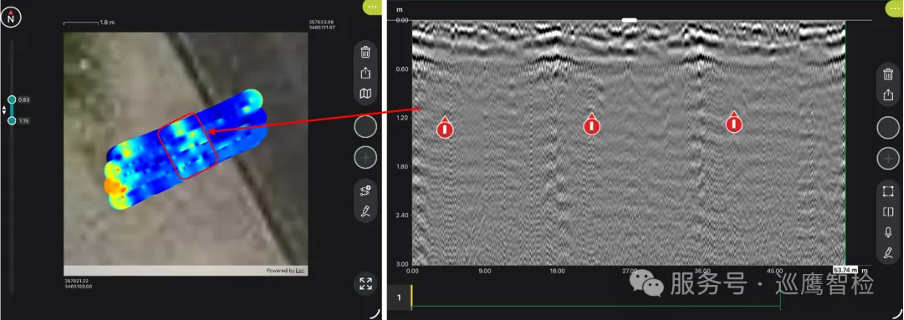
- The data noise is obvious, and the (power conduit) reflected signal is not continuous.
- The features of deep slice and B-scan images are blurred and difficult to read accurately.
- Deep signals are easily covered by noise and cannot meet the precise positioning requirements.
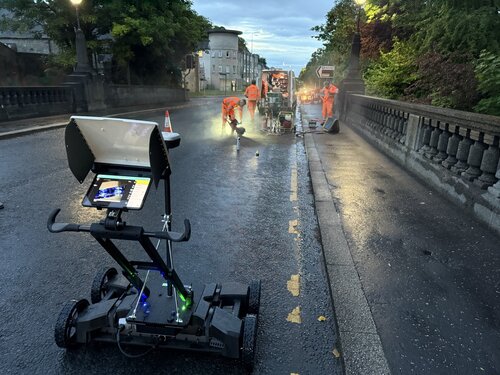
Considering that the newly upgraded dynamic stacking mode of Proceq GS9000 ground-penetrating radar) can effectively improve the data signal-to-noise ratio, we use GS9000 equipped with GX2 antenna to scan the construction area again. The data results show that the noise of the B-scan image is significantly reduced, and the image background is cleaner; the powerline reflection signal in the slice view is continuous and clear.
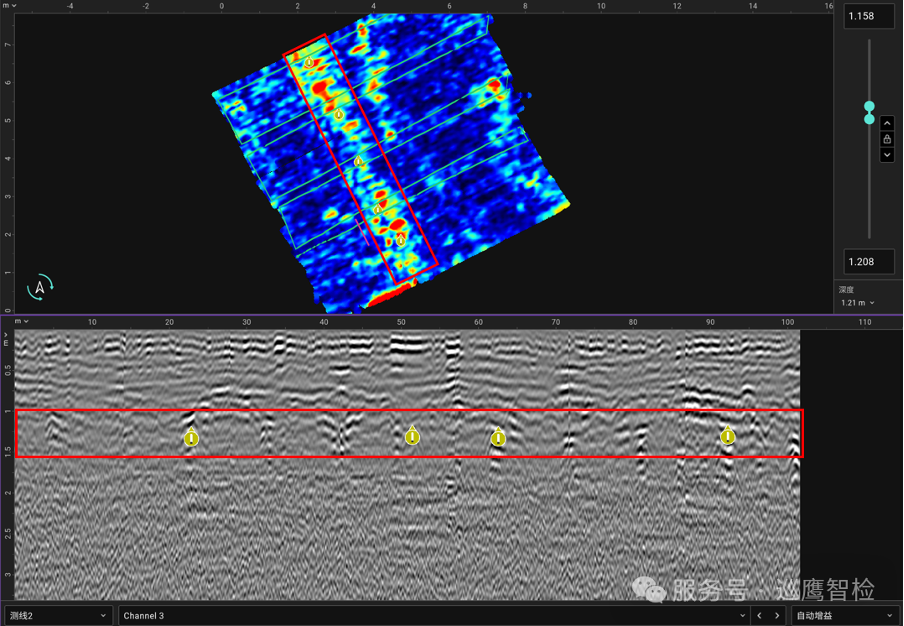
The continuous band-shaped strong reflection signal was successfully identified and determined to be an power conduit, with a depth of about 1.1 meters.
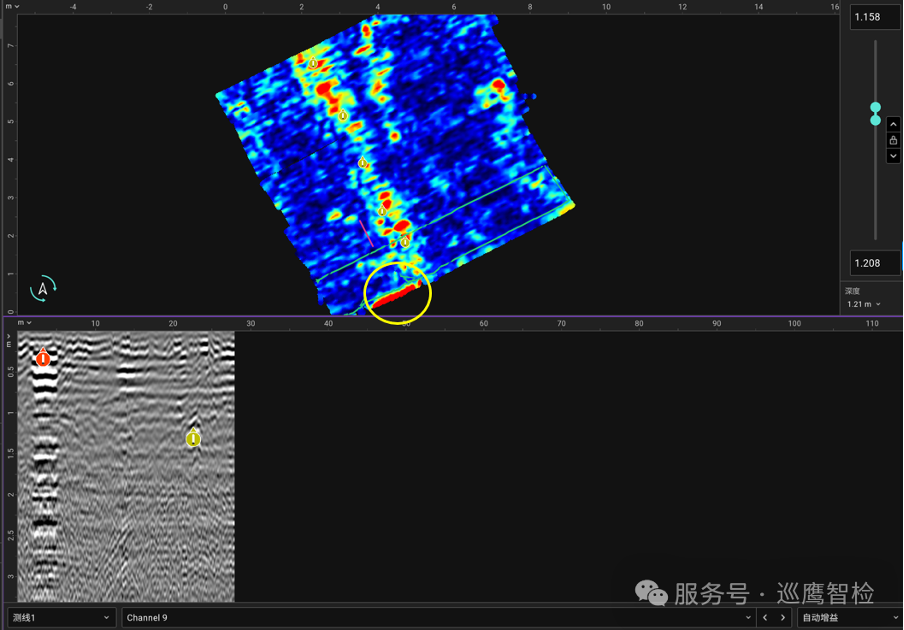
Manhole cover signals at the detection area edge are synchronously identified, confirming the precise position of the conduits.
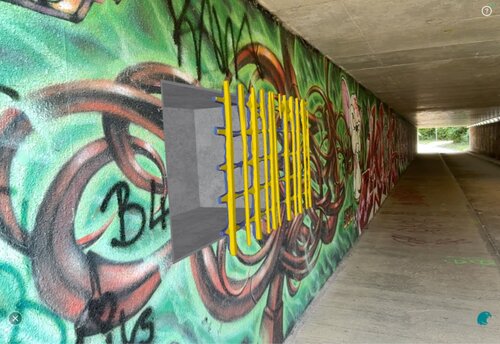
Finally, through the GPR data post-processing software GPR Insights, the 3D reconstruction of powerlines is carried out to realize the visual analysis of underground structures.
Conclusion
Dynamic stacking technology provides core empowerment for underground power conduit detection from the signal processing level, which solves the pain points of traditional detection such as loud noise, weak deep signal, and difficult to suppress interference.
Relying on this technology, Proceq GS9000 GPR can still output high-quality data in complex electromagnetic and stratum environments, realizing accurate positioning, clear imaging and efficient detection of power conduit, and providing reliable non-destructive testing support for construction safety, powerline repair and urban underground facility management.