Initial Field Testing of GPR for External Duct Void Detection
Can an ultra-compact GPR detect defects in external wax-filled tendon ducts? Read the full case study to discover how the Bridgology team used advanced technologies and a custom 3D-printed device to detect hidden, dangerous air voids without drilling a single hole.


Newsletter
Get the best NDT and InspectionTech content delivered straight to your inbox
Testing GPR Accuracy on External Wax-Filled Tendon Ducts
Project Summary
The purpose of this project was to investigate the field feasibility of using GPR for locating defects in external post tension ducts. Bridgology created software that considers the reflections of electromagnetic waves from metallic and air boundaries to locate defects. A full field test was conducted to test the collection process and introduce the method to the USA. Proceq’s ground penetrating radar (GPR), the GP8800, was used to scan several ducts in the bridge segment.
Site Details
This bridge is a precast segmental, post tension box beam superstructure that contains both internal and external, wax-filled tendons. The considered section was constructed between 2017 and 2021. Despite its young age, the bridge has a history of structural issues and a full inspection team was discharged to investigate several different sections of varying priorities. One of the high priority sections was the focus of this trip for the Proceq team and involved scanning both the internal and external tendons. Only the external tendons will be discussed in this report.
Figure 1 shows the site orientation and labeling used during collection and in this report. This section had six concave-up ducts, three on each side (Figure 1). In the middle sections (2, 5) the tendons are expected to be on the top of the duct. The end sections will have a point where the tendons flip from the top to the bottom as the duct continues through the bridge. The inspectors were concerned about water pooling on the bottom of the slope and air collecting at the top. It is impossible to get completely to the top of the duct slopes due to the anchorage but scans were collected up to the anchor face.
Collection on each duct was tested from west to east. A clock face, also facing east, was used to orient collection. Data was collected at 12, 3, 6, and 9 as recommended by Bridgology to visualize the potential problem areas best. In the middle sections (2,5), there was not enough head space between the duct and the beam floor to fit the device. Tendons are pulled to the top of the duct and to the outside of the beam. Defects are more likely to occur opposite to the tendons, so lines were instead collected at either 5 or 7 depending on which was more interior for the side. For example, Section 1 was scanned at 5 o’clock while Section 4 was scanned at 7 o’clock because these locations are more interior to the beam.
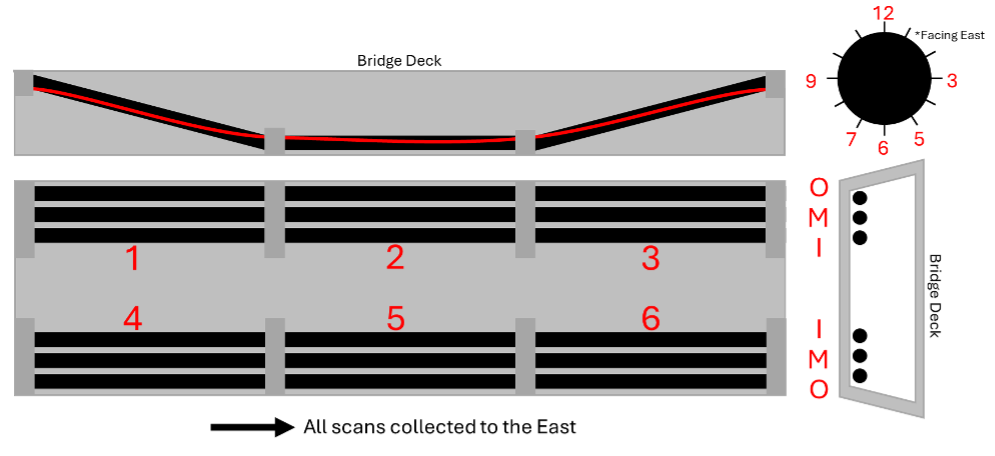
Figure 1: Site orientation and labeling
Device Description
Ground penetrating radar (GPR) devices emit electromagnetic waves into the material to create an image of objects below the surface. A percentage of the wave is reflected at material boundaries depending on the difference in dielectric constant. For example, metals, such as rebar and tendons, have an infinite dielectric constant which creates a strong reflection, clearly appearing in the scan. Air voids can also appear in the scan but have a weaker reflection depending on the difference in dielectric constant between the duct and filler material. There is also a change in wave polarity when reflecting off material boundaries that have a higher or lower dielectric constant than the first material. These principles can be used in post-processing to assess defects.
Proceq has several types of GPR, but the GP8800 (Figure 2) is the only one whose design can accommodate the limited size of the ducts. The footprint of the GP8800 is only 3x3 inches with a modular encoder wheel. This device uses a step frequency continuous waveform with a bandwidth of 400 – 6000 MHz which achieves a high-resolution image capable of detecting smaller defects in the duct.
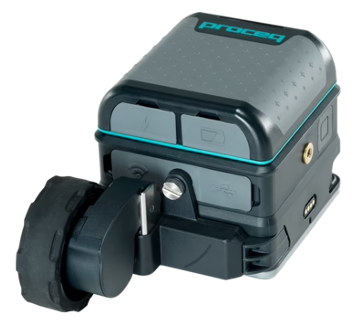
Figure 2: Proceq GP8800
Saddle Description
The GP8800 has a flat bottom which is excellent for most circumstances. However, when on a curved surface like the ducts, a saddle fixture is needed to keep the device properly seated (Figure 4). This custom saddle was designed by Bridgology for different sized PT ducts which can be easily 3D printed for each PT duct configuration (Figure 3). The key feature of this design is the opening at the bottom that allows the center of the GP8800 to consistently contact the duct and give the radar wave a normal incident angle. If this were to be attempted by hand, there would be excessive and inconsistent noise in the data. There is also a sleeve that goes on the wheel to improve contact with the duct and make up for the gap created with the offset wheel on a round surface.
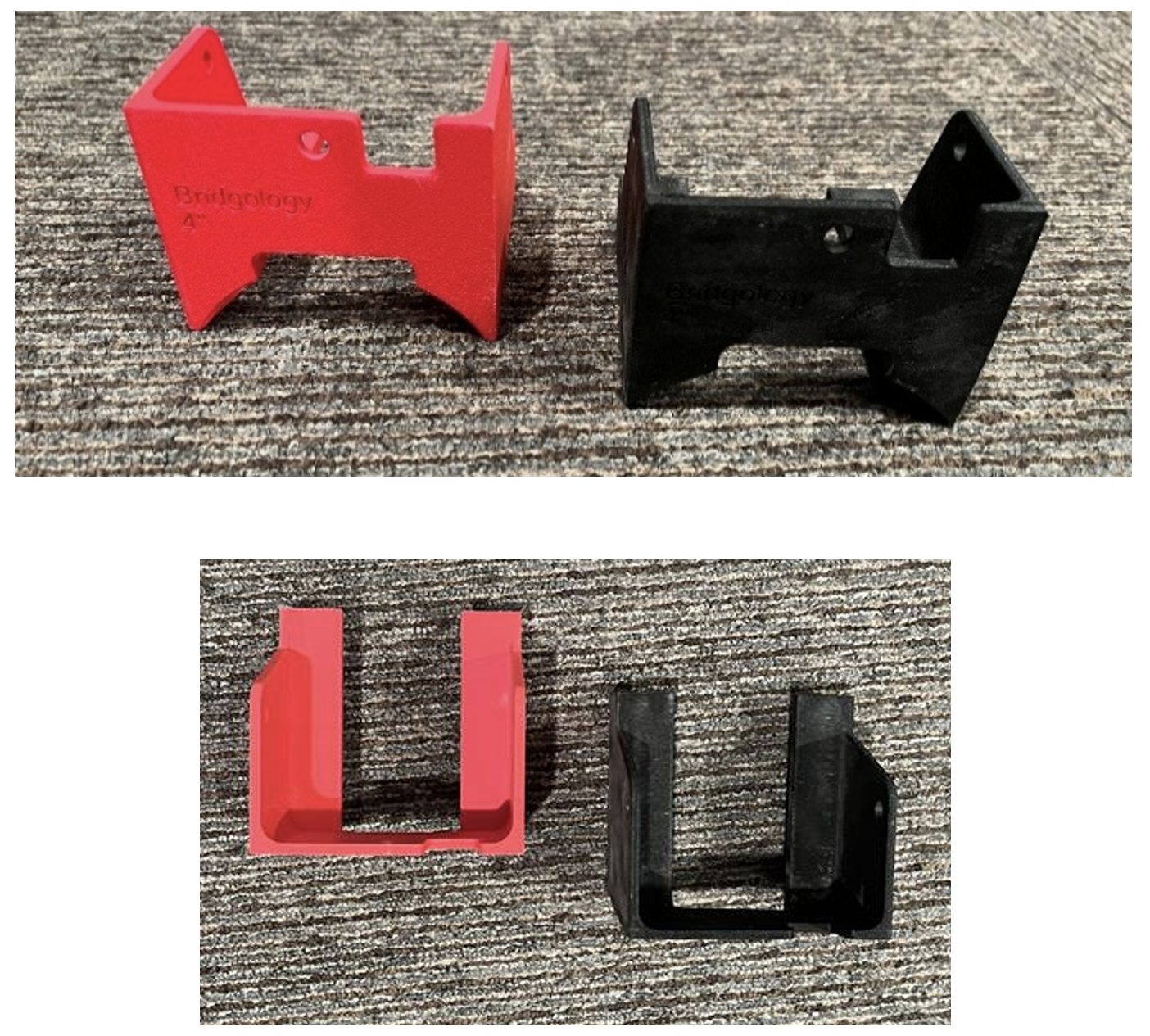
Figure 3: PT duct saddle
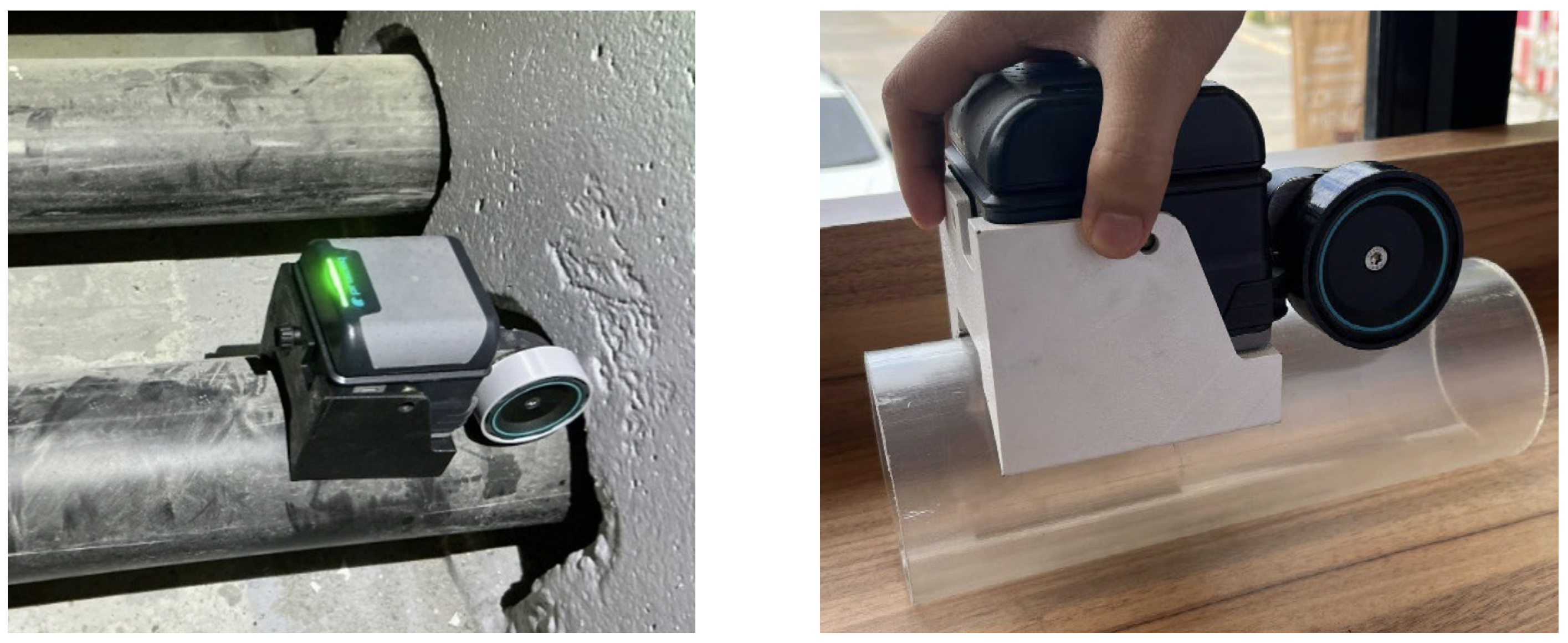
Figure 4: Saddle positioning in the field
Procedure
The in-field procedure was relatively simple. Once collection points and data labeling are organized, the procedure is simply to collect GPR data along the duct at key angles (Figure 5). There is nothing technical going on in the field. The hardest part is simply moving around the obstacles present in the beam. Although, if there is a significant void, it is noticeable on the scan and can be marked directly on the duct. There were also instances where the device had to be carefully lifted over joints in the duct. Figure 6 shows the results directly from the field with no processing.
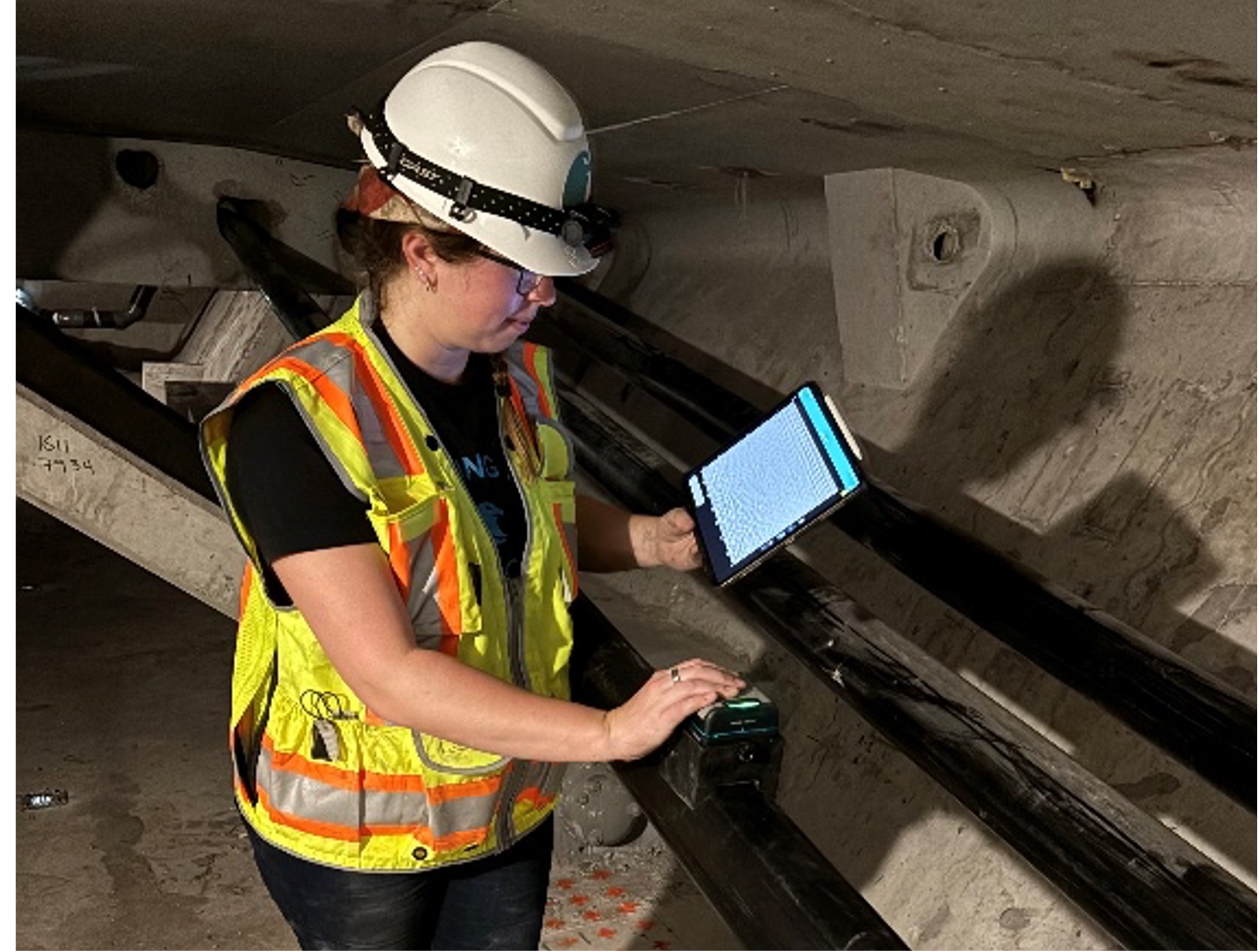
Figure 5: Collecting data
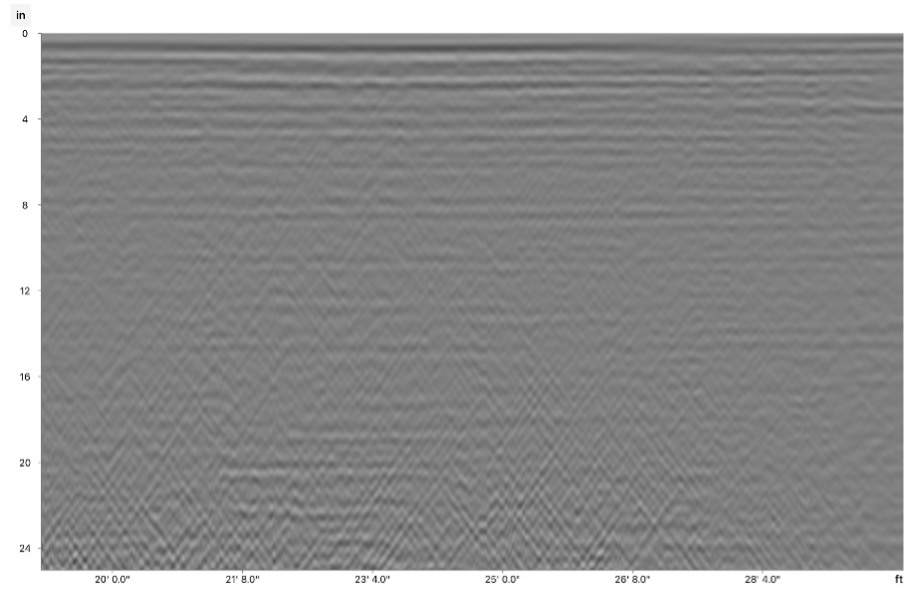
Figure 6: Data collected in the field
Data
Field Feasibility
For this pilot field test with a prototype saddle, it took about 10 minutes to collect four lines of data on a 25-foot tendon. There were welded joints that needed to be carefully lifted over and the length inside the anchorages could not be scanned but the entire duct section was scanned and considered relatively quickly (Figure 7). There were difficulties maneuvering at times as the ducts change elevation or are blocked by obstacles (Figure 8). Higher ducts that require scaffolding or manlifts may have a harder time keeping the device on the duct and in line. There are also times the spacing was not sufficient, and the device could not fit. This could be helped by removing the battery and using a wired connection depending on the allowable space. Several of these issues can be addressed with adjustments to the procedure and saddle for future projects.
Overall, this is very feasible in practice especially if there are specific segments in question. The procedure is simple with no technical requirements.
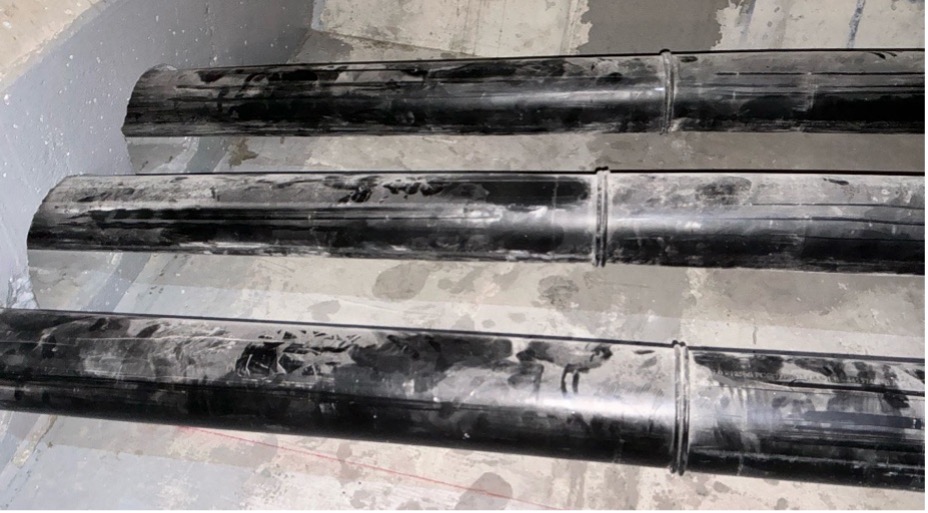
Figure 7: Anchorage and welding joints blockers
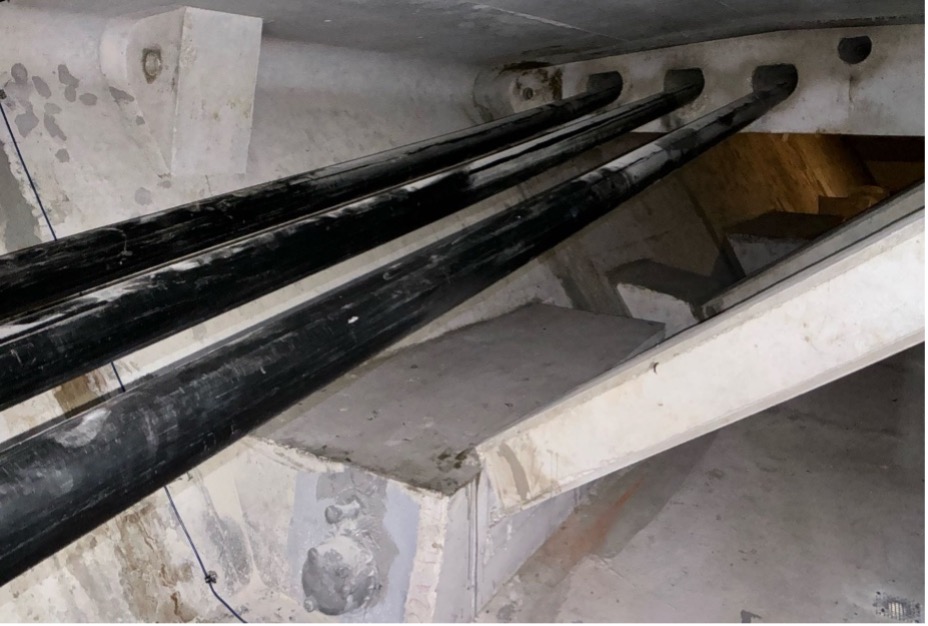
Figure 8: Obstacles around ducts
Defect Analysis Results
Preliminary conclusions can be drawn onsite using the raw B-scan data. If the scan is consistent like Figure 9, this indicates a consistent interface more likely to be filler material than air. Minor inconsistencies like the one circled can indicate shifts or overlaps in tendons. If there is a major inconsistency like that shown in Figure 10, it is likely an internal defect. Bridgology has developed software to further analyze this raw data from GPR to better assess potential air voids. Other concerns like tendon location and condition cannot be performed at this time due to cable geometry scattering the signal.
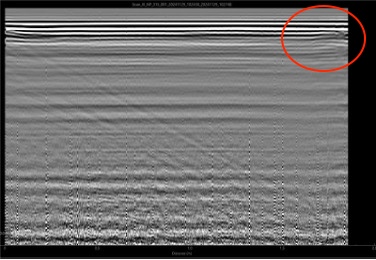
Figure 9: High likelihood of solid filler
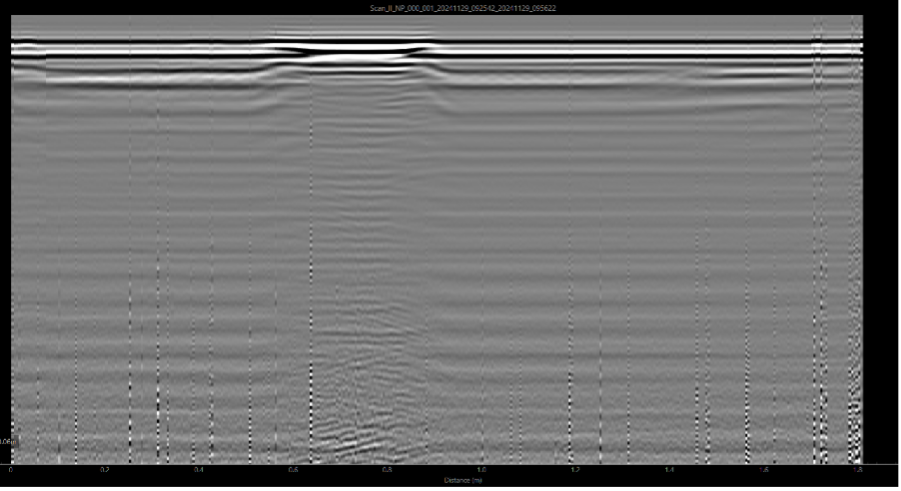
Figure 10: Area of discontinuity indicating a void
Additional processes can be performed on the signal amplitude using the Bridgology software to improve the defect analysis. The software also provides further analysis on statistics and severity using multiple angles of data collection.
The direct wave on the top of the B-scans is selected as the surface of the duct. A certain time after that point depending on the analysis type is chosen. When a duct is in good condition, the wave travels through the ducts, through the filler, to the steel tendons where much of the energy is scattered by the uneven, metallic surface. If there is a defect in the filler, it would provide a closer, sharper surface for reflection so that more energy returns to the device, increasing the amplitude of the signal.
There are two methods of calculating the energy collected by the device. The first, valid for near field projects, is comparing the direct wave at different points in the scan. Figure 11 shows the standard deviation of the duct/filler interface. Significant changes, shown in yellow, indicate a change in the interface material, likely an air void, and allows for enough sensitivity to detect small air voids. In this section, there is very little variation in most of the ducts. The Bridgology analyst stated a higher standard deviation would be expected if there were voids in the ducts even with the wax filling. The minor increases in standard deviation shown in yellow are the areas around the duct welds.
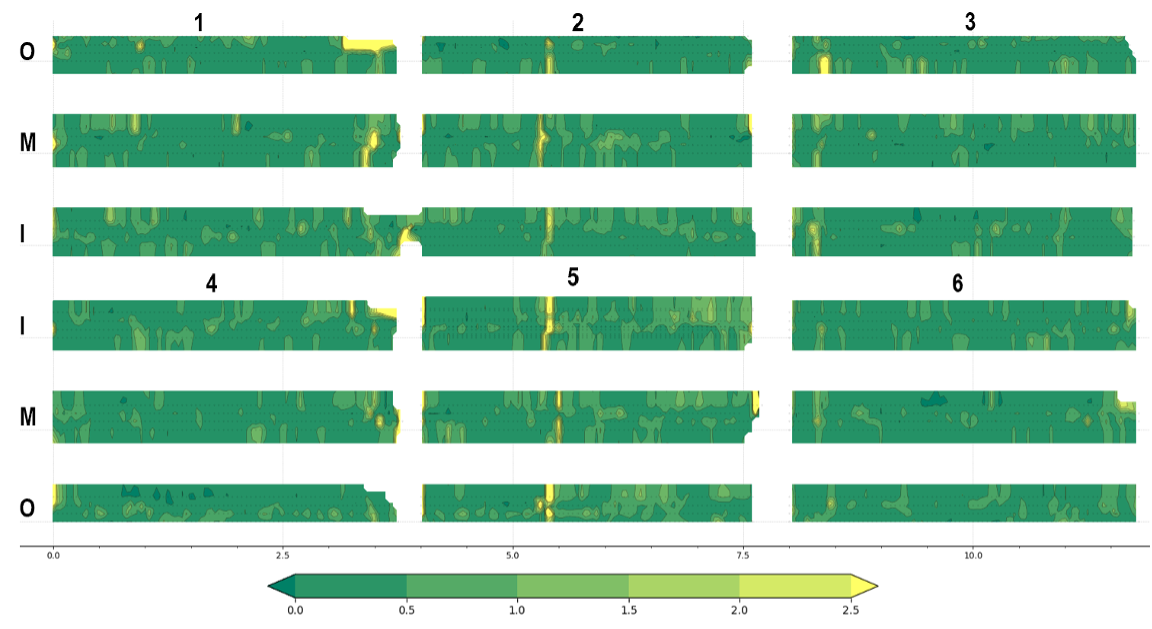
Figure 11: Standard deviation of the duct/filler interface
The other option is to find the absolute value of the signal, also called the envelope, using a similar process to the Hilbert transform. Then, the amplitudes are summed between the direct wave and a specific point in time. The amplitudes are plotted with a normal distribution and the more standard deviations away from the mean, the greater the severity and size. Areas with an air interface would see a comparatively sharp increase in signal amplitude and be shown as a darker red on the homogeneity plot. Figure 12 is the homogeneity plot of the tested section which shows no significant defects.
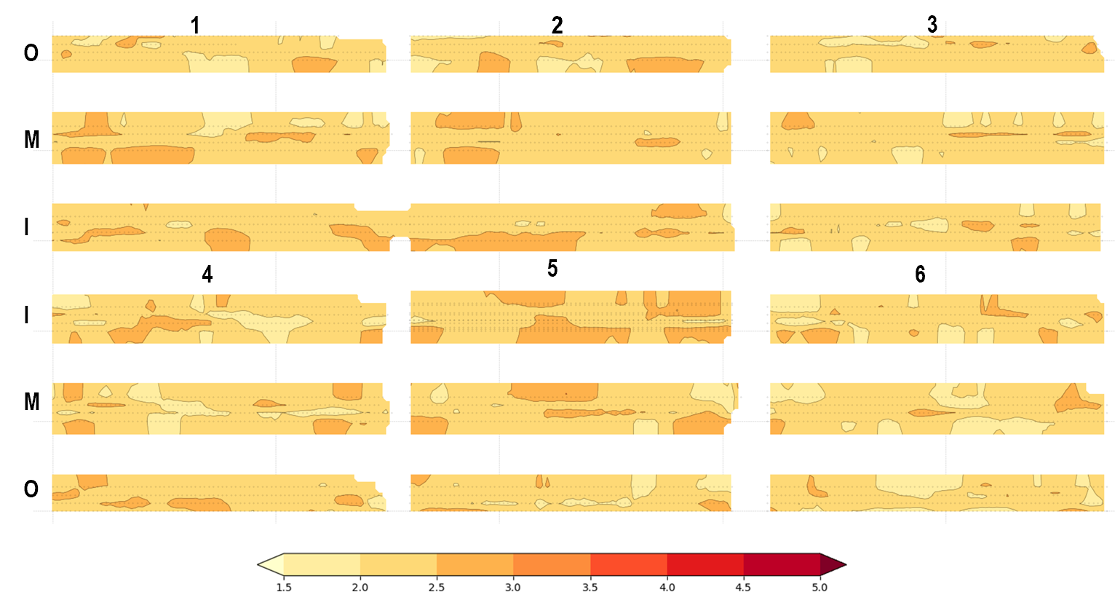
Figure 12: Homogeneity chart of section
In this project, the first method using the standard deviation of the direct wave is a better representation of the data due to the limited depth and lack of consistent, locatable objects (hyperbolas) in the scans, although the second method is still valid. This project is also slightly different than most as a wax filler was used instead of grout. The Bridgology team noted the average duct/wax interface amplitude was higher than what is typical with the duct/grout interface. However, a duct/air interface would still show a more notable change in amplitude.
Conclusion
From this investigation, this section of bridge, despite being a high priority for inspection, appears to be completely filled and without major defects. The new process of investigating external PT ducts using GPR was easy to perform in the field that will improve further with a few tweaks to the beta saddle. Both direct wave deviation and homogeneity testing show no strong discontinuities leading to the conclusion of a solid filler.
Bridgology sells specialized engineering services, like the external tendon evaluation, rather than standalone software, providing infrastructure owners and engineers with nondestructive testing and expert analysis of concrete and masonry structures. They interpret data to produce clear, tailored maps and visual outputs that support condition assessment, risk identification, and maintenance planning.